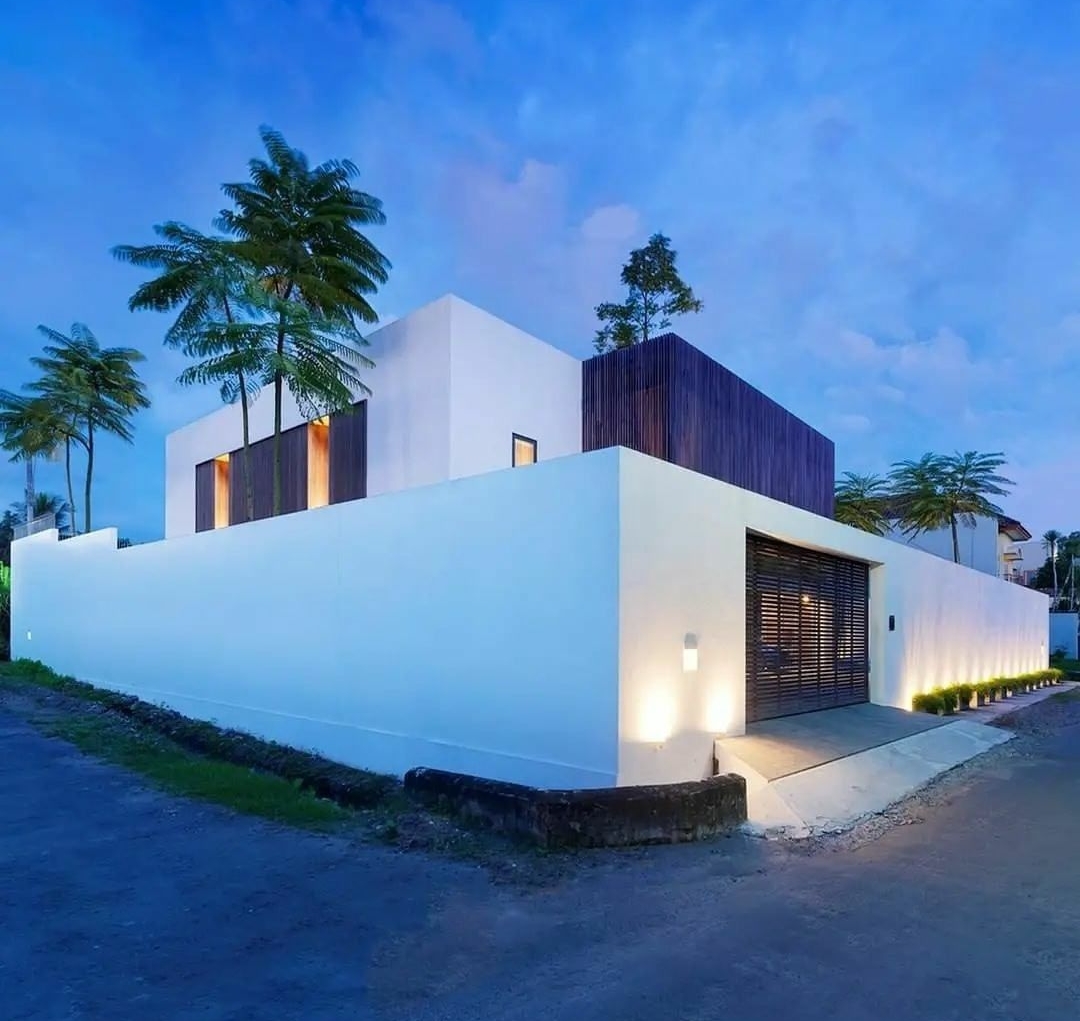
Created by: www.practicalintroduction.com
Elite II Captured From Top
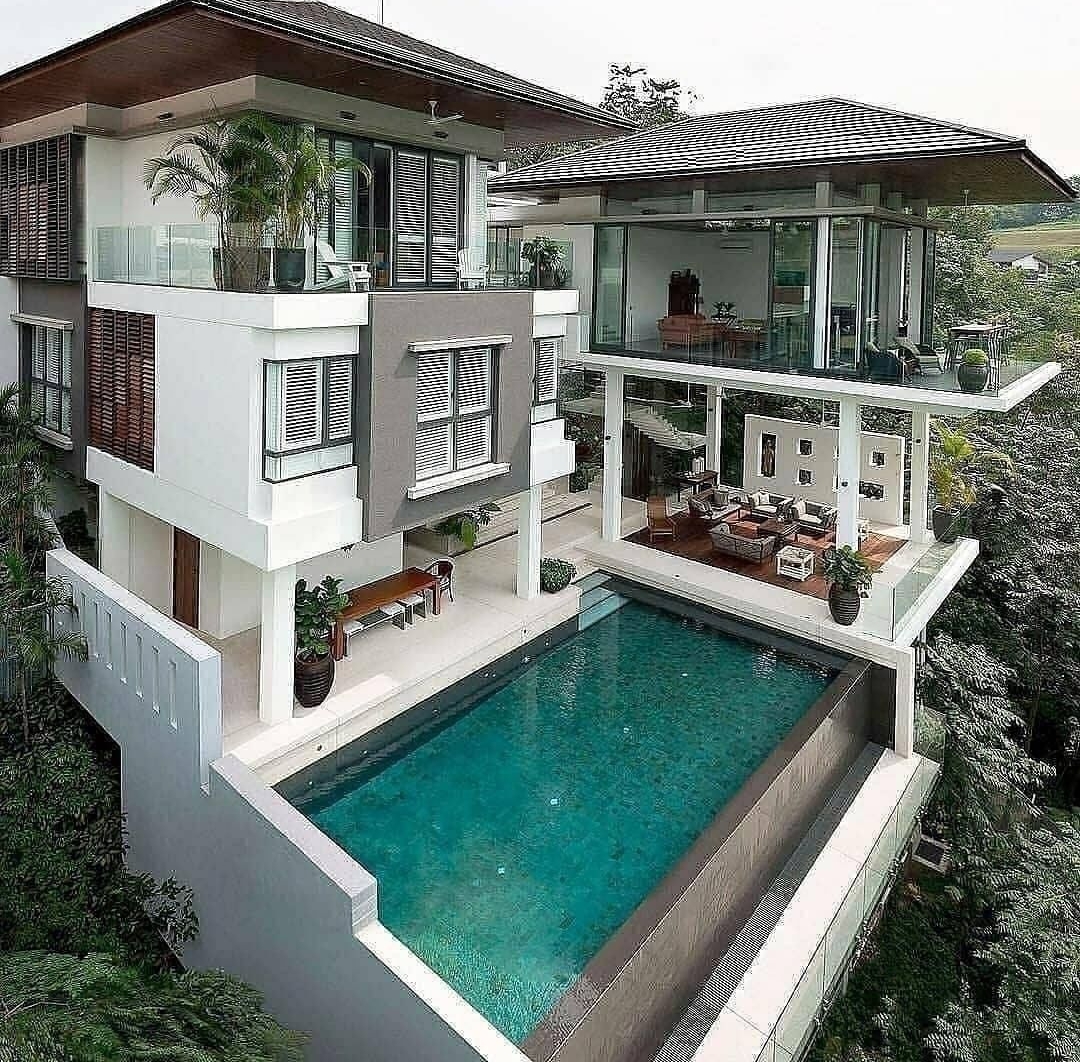

Elite II Captured From 2nd Floor

Elite II Captured From 3nd Floor

Beautiful Glass have Captured from Sitting Room

Beautiful Glass on Double Stage


Minimalist Modern Residential 2 Floors House Design
Are you prefer to search or build
minimalist modern residential 2 Floors
House Design? Why minimalist though? Well, minimalism is simplicity. That's
how the concept of minimalism is identified and associated. Minimalist ideas
have become a kind of belief to display a simple and modern style and pattern
of life.
The modern lifestyle itself
requires everyone to be able to adapt quickly and precisely, according to the
will of the times supported by the speed of development of information technology. Here we will provide you some useful information about 2 Floors House Design and why
minimalist house is aesthetic.
Even so in the world of interior House Design, the minimalist style is almost unmatched as one of the most popular interior concepts and is widely adapted and used for various types of housing.
House Design Along with the development of small types of
residential designs or the minimalist style seems to get the space and
opportunity to show off. It becomes a design concept that is considered the
most suitable for use. In fact, it is not uncommon to be the only interior design style that is most preferred.
· Minimalist is Aesthetics
Having a small house is indeed a
dilemma, the need for space for various functions and purposes is an obstacle
due to the limited land. Well, minimalist house can be “reconstructed” by
raising the floor to 2 floors or any like what you want.
With minimalist style doesn't
show anything monotonous and boring at all. The minimalist concept in a
two-story house is actually the best style choice with its simplicity. It is
not surprising why this design concept has become the most popular choice and
is in great demand by many people.


Painting Styles in Expressionism Art

Painting Styles in Expressionism is a school that prioritizes free inner outpouring. Painting Styles in Expressionism is one example of pure art that prioritizes aesthetic value over practical value. In general, Painting Styles in Expressionism is a picture or expression of the painter. Free in exploring objects that arise from the inner world, imagination, and feelings. The objects depicted include horror, violence, poverty, sadness, and other desires behind human behavior in Painting Styles in Expressionism Art.
Pioneers of Painting Styles in Expressionism Art : Vincent Van Gogh, Paul Gaugiuin, Ernast Ludwig, Karl Schmidt, Emile Nolde, J.J. Kandinsky, and Paul Klee.
Painting Styles in Dadaism Art

Painting Styles in Dadaism was born because of the outbreak of World War I. Painting Styles in Dadaism nature is said to be anti-art, anti-feeling, and tends to reflect rudeness and violence.
His works are strange, such as copying a Painting Styles of Monalisa and giving it a mustache, giving a title to the urinal, and putting it on display. Collage methods Painting Styles are also used, such as wood and scraps of used goods.
Figures of Painting Styles in Dadaism
The characters of Painting Styles in Dadaism genre: Juan Gross, Max Ernst, Hans Arp, Marcel Duchamp, and Picabia.
Painting Styles in Futurism Art

Painting Styles in Futurism Art is a genre painting Styles that was born in 1909. This school emphasizes the beauty of motion and Painting Styles is seen as a break from the Cubist school, which Painting Styles is considered static in composition, line, and coloring.
Painting Styles in Futurism is so devoted to motion that in painting Styles , dogs are depicted with more than four legs.
Figure Flow of Painting Styles in Futurism
Characters of this genre Painting Styles : Umberto, Boccioni, Carlo Cara, Severini, Gioccomo Ballad, and Ruigi Russalo.
Read more list on my website "
Romanticism Painting Art

Romanticism is a style of art that tries to show things that are fantastic, irrational, and beautiful.
This genre depicts romantic stories about terrible tragedies and dramatic events that are usually shown in romance stories.
The depiction of the object is less than reality; the colors are more lively, the movement more agile, and the man is more manly.
The characteristics of Romantic painting art are as follows:
- Paintings contain powerful and emotional stories.
- It has a lot of movement and dynamics.
- The colors are contrasting and festive.
- Dynamic composition settings.
- It contains bitterness and touching feelings.
- Awesomeness exceeds reality.
Don’t forget to bookmark and always visit every day Practicalintroduction.com because you can find here the latest Tech Computer Android games How-to Guide Tips&Tricks Software Review etc, Which we update every day.
Impressionist Painting Art

Impressionism is an art movement from the 19th century that started in Paris in the 1860s. The name was originally quoted from Claude Monet's painting, "Impression, Sunrise" ("Impression, Soleil Levant"). The critic Louis Leroy used this word as a satire in his article in Le Charivari.
The main characteristics of Impressionist painting are strong brush strokes, bright colors (in fact, many Impressionist painters forbid black because it is considered not part of the light), open composition, emphasis on lighting quality, and painting subjects that do not stand out too much, and angles. An unusual view The influence of Impressionism in the visual arts also extended to the fields of music and literature.
An Explanation of Impressionism Painting Art
Read more :
Impressionist artists were initially inspired by the theories of Eugene Delacroix, who began to feel dissatisfaction with the development of academic art at that time, which was too concentrated on the classical painting school. He argues that painting is not always formed by excessive processing of lines, as developed by the British over the years. On the other hand, calculating the color fields will produce a painting that is no less interesting.
However, Delacroix himself can be considered as failing to escape from the influence of academy painting standards because, after all, his own paintings still concentrate on ideal forms.
Then some painters radically violated academic rules in painting. This painting no longer concentrates on shape in detail by emphasizing contours, volumes, and lines. Also, leave the structural observation of an object's shape.
On the other hand, the atmosphere is obtained by capturing the impression (or impression) of light that is caught at a glance by the eye. As a result, the shape of the object becomes simpler, unlike in naturalism or realism painting.
At first, not only still life paintings and portraits were made indoors, but also landscapes. This then prompted impressionist artists to find that there is a different impression obtained if the painting is made in an open area by directly observing the object created.
They use strokes of short, broken, and at the same time pure (meaning not meant to be mixed in the palette) to give life to the painting. The emphasis of the painting then shifts to the overall impression rather than the details of a particular object.
Further development of impressionism was the discovery that more important than the technique of impressionism itself was the difference in point of view. Impressionism is actually the art of movement, pose, and composition through the play of light impressions that are poured into bright and varied colors.
People began to believe in the late nineteenth century that impressionism was a clear and honest view of life, despite the fact that it was not the artistically correct approach to creating works.
The peak of the Impressionist art movement in France occurred almost at the same time as in other countries, including Italy with the painter Macchiaioli and the United States with the painter Winslow Homer.
Impressionism became a pioneer in the development of other modern art schools, such as Post-Impressionism, Fauvism, and Cubism.
The characteristics of Impressionist painting are as follows:
- Short, thick brush strokes in a sketch-like style, make it easier for the painter to capture the essence of the subject rather than the details.
- Color is obtained with the least possible mixing of paint pigments. It is expected that the colors are mixed optically by the retina.
- Shadows are created by mixing complementary colors (black is not used as a shadow).
- Paint is not allowed to dry to be overwritten with the next color.
- Processing of paint transparency properties is avoided.
- Investigating as thoroughly as possible the nature of light reflection from an object, which will then be used in the painting
- worked outdoors (en Plein air).
Actually, this characteristic can almost be found in other schools, but only impressionism has this characteristic as a whole on purpose.
Don’t forget to bookmark and always visit every day Practicalintroduction.com because you can find here the latest Tech Computer Android games How-to Guide Tips&Tricks Software Review etc, Which we update every day.
How to Set Page Margins in Microsoft Word Realism Painting Art

Realism in the fine arts means the effort to present the subject in work as it appears in everyday life without the addition of certain embellishments or interpretations.
The meaning can also refer to the effort in the art to show the truth, even without hiding the bad things. The discussion of realism in art can also refer to the cultural movement that started in France in the mid-19th century.
However, works based on the idea of realism existed as early as 2400 BC in the city of Lothal, which is now known as India.
Realism as a cultural movement Realism became famous as a cultural movement in France as a reaction to the notion of Romanticism that had been established in the mid-19th century. This movement is usually closely associated with social struggle, political reform, and democracy.
Realism then dominated the world of art and literature in France, England, and the United States from 1840 to 1880. Adherents of French realism literature include the names, Honoré de Balzac and Stendhal. While Gustave Courbet and Jean François Millet are the most well-known realist artists.
Realism in the fine arts Realist artists always tries to present the daily lives of characters, atmospheres, dilemmas, and objects, in order to achieve the goal of verisimilitude (very alive). Realist artists tend to ignore theatrical dramas, subjects that appear in too wide a space, and other classical forms that were already popular at that time.
In a broader sense, realism will always occur whenever an artist tries to accurately observe and imitate forms in nature. For example, the photo painter of the Renaissance, Giotto, could be categorized as an artist with realist work, because his work has better imitated the physical appearance and volume of objects than anything attempted since the Gothic era.
Honesty in presenting every detail of objects can also be seen in the works of the Rembrandt Barbizon School, focusing on a closer look at nature, which then paved the way for the development of impressionism.
In England, the Pre-Raphaelite Brotherhood rejected the idealism of Raphael's followers, which then led to a more intense approach to realism, which is known as one of the best realist artists.
The Trompe l'oeil technique is an art form that extremely shows the artist's efforts to present the concept of realism.
The following are examples of realism in painting art:
Don’t forget to bookmark and always visit every day Practicalintroduction.com because you can find here the latest Tech Computer Android games How-to Guide Tips&Tricks Software Review etc, Which we update every day.
Naturalism Painting Art

Naturalism is a form of painting (fine art) in which the artist tries to describe everything in accordance with nature or the real world, meaning that it is adapted to catch our eyes.
In order for the paintings that are made to be very similar or exactly like the real thing, the arrangement, comparison, perspective, texture, coloring, and dark light are done as accurately as possible and precisely.
In this flow, I'm trying to display realistic objects with an emphasis on natural settings. This is a further deepening of the realism movement in the 19th century as a reaction to the establishment of romanticism.
One of the artists of naturalism in America was William Bliss Baker, whose landscape paintings are considered the best realist paintings of this movement.
An important part of the naturalist movement is Darwinism's view of life and the damage humans have caused to nature.
The following are the figures of Naturalism in Painting Art:
Romantic Painting Art - Practicalintroduction Rainbow

Romanticism is a rebellion against the Neo-Classical flow, where Jean Jacques Rousseau invites us back to nature, as humans who not only have thoughts but also feelings and emotions.
Romantic paintings tend to show:
Things that deal with one's feelings (strongly opposed in Neo-Classical schools) are Exotic, longing for the past, used for the feelings of the audience. Beauty and good looks are always described.
The characteristic features of Romantic painting art are as follows:
- Paintings contain powerful and emotional stories.
- It has a lot of movement and dynamics.
- The colors are contrasting and festive.
- dynamic composition settings.
- It contains bitterness and touching feelings.
- Awesomeness exceeds reality.
The characters of Romantic painting include:
The figure who was truly rebellious and who first planted the banner of romanticism was Teodore Gericault (1791–1824) with his work entitled "RAKIT MENDUSA". Romanticism comes from the French "Roman" (story), so this genre always describes a story about a great deed or a terrible tragedy.
Don’t forget to bookmark and always visit every day Practicalintroduction.com because you can find here the latest Tech Computer Android games How-to Guide Tips&Tricks Software Review etc, Which we update every day.
Neo-Classical Painting Art

The outbreak of the French revolution in 1789 marked the endpoint of feudalism in France, whose influence was also felt in other parts of the world.
This revolution is not only a change in the political and social order, but also concerns the life of the arts. Artists are free to follow their respective vocations, meaning they work not because of order but simply because they want to paint.
Read more :
So thus begins the history of modern painting in history, which is characterized by individualization and self-isolation. Jacques Louis David was the first painter of the modern scene. In 1784, David described the "HORATII Oath". This painting depicts Horatius, the father, standing in the middle of the room, swearing at his three sons, clustered on the left, while his daughter is weeping on the right.
This painting is not used for enjoyment, but to educate and instill awareness of community members' responsibilities towards the state. J.L. David is a pioneer of the Neo-Classical flow, where Neo-Classical painting is rational, objective, full of discipline and order, and classical.
Characteristic features of Neo-Classical Painting Art are as follows:

- Showing design in merge

- Elite design from behind the garden

- Semi Elite the balcon room

- Elite badroom for romantic couple

- Beautiful Lighting showed from the night