Tampilkan postingan dengan label Semi conductor. Tampilkan semua postingan

Neuromorphic Spintronics - Neuromorphic Computing with Spin Torque Nano-oscillators


Neuromorphic-Spintronics-Neuromorphic-Computing-with-Spin-Torque-Nano-oscillators-1

Neuromorphic computing uses basic principles inspired by the brain to design circuits that perform artificial intelligence tasks with superior energy efficiency. Traditional approaches have been limited by the energy area of artificial neurons and synapses realized with conventional electronic devices.

In recent years, multiple groups have demonstrated that spintronic nanodevices, which exploit the magnetic as well as electrical properties of electrons, can increase the energy efficiency and decrease the area of these circuits. Among the variety of spintronic devices that have been used, magnetic tunnel junctions play a prominent role because of their established compatibility with standard integrated circuits and their multifunctionality.

Magnetic tunnel junctions can serve as synapses, storing connection weights, functioning as local, nonvolatile digital memory or as continuously varying resistances. As nano-oscillators, they can serve as neurons, emulating the oscillatory behavior of sets of biological neurons. As superparamagnets, they can do so by emulating the random spiking of biological neurons. Magnetic textures like domain walls or skyrmions can be configured to function as neurons through their non-linear dynamics.

Several implementations of neuromorphic computing with spintronic devices demonstrate their promise in this context. Used as variable resistance synapses, magnetic tunnel junctions perform pattern recognition in an associative memory. As oscillators, they perform spoken digit recognition in reservoir computing and when coupled together, classification of signals. As superparamagnets, they perform population coding and probabilistic computing.

Simulations demonstrate that arrays of nanomagnets and films of skyrmions can operate as components of neuromorphic computers. While these examples show the unique promise of spintronics in this field, there are several challenges to scaling up, including the efficiency of coupling between devices and the relatively low ratio of maximum to minimum resistances in the individual devices.


Neuromorphic-Spintronics-Neuromorphic-Computing-with-Spin-Torque-Nano-oscillators-2

figure 1.

(a) Magnetic tunnel junctions for memory applications. A magnetic junction consists of two ferromagnetic layers (gray) separated by an insulating layer (blue) with the magnetization of one layer fixed and that of the other either parallel (low resistance) or antiparallel (high resistance) to it.

(b) Cross-bar array of magnetic tunnel junctions for high density storage (Magnetic Random Access Memory). The resistance of a particular tunnel junction is measured by activating the appropriate word line (red) allowing conduction between the bottom bit line and the top sense line (both blue). The alignment of the magnetization can be switched by passing sufficient currents through the device.

(c) Associative memory. (i) Handwritten digits from the MNIST dataset used for training the associative memory. (ii) Sample test input after training. (iii) Output of trained network from the test input showing successful association.


Neuromorphic-Spintronics-Neuromorphic-Computing-with-Spin-Torque-Nano-oscillators-3

Figure 2. Neuromorphic computing with Spin Torque nano-oscillators. 

(a) Schematic spin torque nano-oscillator. When designed appropriately, the free layer magnetization of a tunnel junction precesses when a dc current is passed through it. Because of the oscillating magnetoresistance, a fixed input current gives an oscillating voltage across the junction. 

(b) Reservoir computing with a spin torque nano-oscillator. Using time multiplexing in pre- and post-processing, a single spin torque nano-oscillator gives state of the art performance as a reservoir in a reservoir computing scheme. 

(c) Schematic use of coupled nano-oscillators for vowel recognition. The input is represented by the frequencies of two microwaves applied through a stripline to the oscillators. The natural frequencies of the oscillators are tuned by dc bias currents through the devise. These can be tuned so that the synchronization pattern between the oscillators corresponds to the desired output.

Neuromorphic-Spintronics-Neuromorphic-Computing-with-Spin-Torque-Nano-oscillators-4

Figure 3

(a) Schematic skyrmion structure. The magnetization direction of a single skyrmion is schematically given both by the directions of the arrows and the color coding, ranging from blue for magnetization up, through white for in-plane magnetization directions, to red for magnetization down. (b) Simulated skyrmion assembly. A reservoir computing scheme based on skyrmions in a random potential makes use of the distortions of the assembly due to current flow to provide the necessary non-linearity and memory.


Read more:

Ultrafast Switch from a Bose-Einstein Condensate Matter - Practicalintroduction

A Theoretical Perspective : Spin−Orbit Coupling in 2D Semiconductors

Bill Gates Reveals Technology That Will Dethrone Smartphones, What The Technology Is?

Measurement of the Higgs boson mass and width using the four-lepton final state in proton-proton collisions at √s = 13 TeV

Cellular Lasers for Cell Imaging and Biosensing


References :

1. Big data needs a hardware revolution. Nature (2018). doi:10.1038/d41586-018-01683-1 

2. Furber S Large-scale neuromorphic computing systems. J. Neural Eng 13, 051001 (2016). [PubMed: 27529195] 

3. Indiveri G et al. Neuromorphic silicon neuron circuits. Neuromorphic Eng 5, 73 (2011). 

4. Locatelli N, Cros V & Grollier J Spin-torque building blocks. Nat. Mater 13, 11–20 (2014). [PubMed: 24343514] 

5. Grollier J, Querlioz D & Stiles MD Spintronic Nanodevices for Bioinspired Computing. Proc. IEEE 104, 2024–2039 (2016).

Share:

2022 Basic of Spintronics (Giant Magnetoresistance Basics) By Management Practicalintroduction

Electrons have a charge and a spin, but until recently, charges and spins have been considered separately. 


In conventional electronics, the charges are manipulated by electric fields but the spins are ignored. Other classical technologies, magnetic recording, for example, are using the spin but only through its macroscopic manifestation, the magnetization of a ferromagnet. 


This picture started to change in 1988 when the discovery Baibich et al., 1988 and Binash et al., 1989 of the giant magnetoresistance GMR of the magnetic multilayers opened the way to an efficient control of the motion of the electrons by acting on their spin through the orientation of a magnetization. 


This rapidly triggered the development of a new field of research and technology, today called spintronics and, like the GMR, exploiting the influence of the spin on the mobility of the electrons in ferromagnetic materials. 


Actually, the influence of the spin on the mobility of the electrons in ferromagnetic metals, first suggested by Mott 1936, had been experimentally demonstrated and theoretically described by Albert Fert on his Ph.D. thesis almost 20 years before the discovery of 1988. 


The GMR was the first step on the road of the exploitation of this influence to control an electrical current. Its application to the read heads of hard disks greatly contributed to the fast rise in the density of stored information and led to the extension of the hard disk technology to consumer’s electronics. Then, the development of spintronics revealed many other phenomena related to the control and manipulation of spin currents. 


This field of research is expanding considerably, with very promising new axes like the phenomena of spin transfer, spintronics with semiconductors, molecular spintronics, or single-electron spintronics. GMR and spintronics take their roots from previous research on the influence of the spin on the electrical conduction in ferromagnetic metals Mott, 1936; Fert and Campbell, 1968, 1971, 1976; Loegel and Gautier, 1971. 


www.practicalintroduction.com

Fig. 1


The spin dependence of the conduction can be understood from the typical band structure of a ferromagnetic metal shown in Fig. 1. The splitting between the energies of the “majority spin” and “minority spin” directions spin up and spin down in the usual notation makes that the electrons at the Fermi level, which carry the electrical current, are in different states for opposite spin directions and exhibit different conduction properties. This spin-dependent conduction was proposed by Mott 1936 to explain some features of the resistivity of ferromagnetic metals at the Curie temperature. 


However, in 1966, when Albert Fert started in his Ph.D. thesis, the subject was still almost completely unexplored. With his supervisor, Ian Campbell, proposed that he investigate it with experiments on Ni- and Fe-based alloys and had the privilege to be at the beginning of the study of this topic. He could confirm that the mobility of the electrons was spin dependent and, in particular, showed that the resistivities of the two channels can be very different in metals doped with impurities presenting a strongly spin-dependent scattering cross section. 


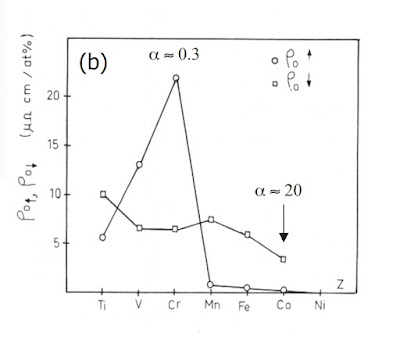
In Fig. 2, the example of the spin up majority spin and spin down minority spin resistivities of nickel doped with 1% of different types of impurities.


www.practicalintroduction.com
Fig. 2


It can be seen that the ratio alpha of the spin down resistivity to the spin up one can be as large as 20 for Co impurities or, as well, smaller than 1 for Cr or V impurities, consistent with the theoretical models developed by Jacques Friedel for the electronic structures of these impurities. The two-current conduction was rapidly confirmed by other groups and, for example, extended to Co-based alloys by Loegel and Gautier 1971 in Strasbourg.


reference :

Awschalom, D. D., and M. E. Flatté, 2007, Nat. Phys. 3, 153.

Baibich, M. N., J. M. Broto, A. Fert, F. Nguyen Van Dau, F. Petroff, P. Etienne, G. Creuzet, A. Friederich, and J. Chazelas, 1988, Phys. Rev. Lett. 61, 2472.

A. Fert, 2008, Rev. Mod. Phys. 80, 1517.


Share:

Happy Wolrd Teacher Day

Daily Page View

Label

Adobe Acrobat Adobe Photoshop Alexa Rank Andorid Application Art Austria BUMN Beginner Belgium Blog Community Blogger Bupati Gresik CPNS/PPPK Canada Coin Market Cap Computers Cosmology Cryptocurrency Dancing Denmark Doctoral Doker Education Educational Excel Excel Table Features Film Finland French Gadget Gallery Garuda Emas Germany Google Analytics Google Form Hardware Homestay Hong Kong Ilovepdf Indrawan Vpp Interior Design Ireland Italy KKPR dan PKKPR Kampung hijau Karang Taruna Karir/Career Keyword Keywords LKPM LaTeX Linux Lowongan Kerja BUMN/SWASTA Mac Majalah Tech Material Physics Material Physics. Mechanical Engineering (ME) Microsoft 365 Microsoft Excel Microsoft Office Microsoft PowerPoint Microsoft Word NFC Nero Nero Burning 2021 Networking New Technology OSS RBA OTOMOTIF Operating Systems Optic PDF PT Aerotrans Services Indonesia (Garuda Indonesia Group) PT Astra Tol Nusantara (ASTRA Infra) PT Indomarco Prismatama (Indomaret Group) PT Indonesia Epson Industry PT Jakarta Industrial Estate Pulogadung PT Pertamina Training & Consulting (PTC) PT. Indofarma (Persero) PT. Kimia Farma Group Perizinan Berusaha Persetujuan Lingkungan Pinjaman Online Posgraduate Postgraduate PowerPoint Presentations Profil Perusahaan/Company Profil Profil-Perusahan Publisher Pyrolysis Quantum Computing Quantum Physics Quiz Renewable Energy Research SEO SWASTA Scholarship Semi conductor Semiconductor Sertifikat Halal Smartphone Spintronic Study Abroad Super Capasitor Superconductor Tata Cara Pendaftaran Surat Izin Usaha Industri (SIUI) Technology Tecnology Thailand The Best Trip & Travel Tutorial United Kingdom United Stated United States VGA card Website Windows 365 Windows Tips Word Document WordPress Zero Waste chromium tricks font iphone iphone 13 Pro iphone 13 Pro Max iphone 13 Pro Max gsmarena online zodiak