Tampilkan postingan dengan label Quantum Physics. Tampilkan semua postingan

Measurement of the Higgs boson mass and width using the four-lepton final state in proton-proton collisions at √s = 13 TeV

 Measurement-of-the-Higgs-boson-mass-and-width-using-the-four-lepton-final-state-in-proton-proton-collisions-10


A measurement of the Higgs boson mass and width via its decay to two Z bosons is presented. Proton-proton collision data collected by the CMS experiment, corresponding to an integrated luminosity of 138 fb^−1 at a center-of-mass energy of 13 TeV, is used. The invariant mass distribution of four leptons in the on-shell Higgs boson decay is used to measure its mass and constrain its width. This yields the most precise single measurement of the Higgs boson mass to date, 125.04 ± 0.12 GeV, and an upper limit on the width Γ H < 330 MeV at 95% confidence level. A combination of the on-and off-shell Higgs boson production decaying to four leptons is used to determine the Higgs boson width, assuming that no new virtual particles affect the production, a premise that is tested by adding new heavy particles in the gluon fusion loop model. This result is combined with a previous CMS analysis of the off-shell Higgs boson production with decay to two leptons and two neutrinos, giving a measured Higgs boson width of 3.0 +2.0, −1.5 MeV, in agreement with the standard model prediction of 4.1 MeV. The strength of the off-shell Higgs boson production is also reported. The scenario of no off-shell Higgs boson production is excluded at a confidence level corresponding to 3.8 standard deviations.


Higgs boson mass and width measurements with on-shell production

The Higgs boson mass and width are measured, using on-shell production, by fitting the m4ℓ distribution in the mass range 105 < m4ℓ < 140 GeV. The results have been determined using the CMS statistical analysis tool COMBINE, which is based on the ROOFIT and ROOSTATS frameworks. Table 1 shows the mass measurements obtained from the 1D approach, where no further assumptions have been made. In comparison to the 1D model, the 1D′BS model reduces the uncertainty by about 15%. Implementing the δm4ℓ/m4ℓ categorization then gives the N –1D′BS model, which leads to an additional 10% improvement. Finally, using the D kin, bkg discriminant to reduce the background produces the N –2D′BS model with another 4% improvement. Table 5 shows the resulting m4ℓ measurements using this last model. All the measured m4ℓ values from the different fits are statistically compatible, given their uncertainties and correlations. Figure 1 displays the observed 1D likelihood scans as functions of mH, from the fits for the different 4ℓ categories and combined. Combining all the m4ℓ final states and data-taking years, our final result is mH = 125.04 ± 0.11 (stat) ± 0.05 (syst) = 125.04 ± 0.12 GeV. The largest systematic uncertainty is from the lepton momentum scale and equals 0.03 and 0.04 GeV for final states with muons and electrons, respectively. 

Table 1: Best fit values for the mass of the Higgs boson measured in the inclusive 4ℓ final state and separately for different flavor categories using the 1D approach. Uncertainties are separated into statistical and systematic uncertainties. Expected uncertainties are also given assuming mH = 125.38 GeV 

Measurement-of-the-Higgs-boson-mass-and-width-using-the-four-lepton-final-state-in-proton-proton-collisions-1

Table 2: Best fit values for the mass of the Higgs boson measured in the inclusive 4ℓ final state and separately for different flavor categories, using the final fit configuration (N –2D’BS). Uncertainties are separated into statistical and systematic uncertainties. Expected uncertainties are also given assuming mH = 125.38 GeV.

Measurement-of-the-Higgs-boson-mass-and-width-using-the-four-lepton-final-state-in-proton-proton-collisions-2


As a check on the analysis technique and the systematic uncertainty from this method, the 1D′BS model is applied to Z → 4ℓ events in the m4ℓ range 70–105 GeV. The signal shape is obtained using a convolution of a Breit–Wigner function and a double-sided Crystal Ball function. The fitted values of mZ in different subchannels are m4µ Z = 91.02 ± 0.14 GeV, m4e Z = 91.18 ± 0.45 GeV, m2e2µ Z = 91.40 ± 0.29 GeV, and m2e2µ Z = 91.40 ± 0.37 GeV, leading to a combined value of mZ = 91.17 ± 0.12 GeV, consistent with the world-average Z boson mass and with the uncertainty in agreement with the expected value of ± 0.12 GeV from simulation. The results from this analysis are combined with those extracted using data recorded with the CMS detector during Run 1 at √ s = 7 and 8 TeV. Since this analysis uses an improved method to extract the systematic uncertainties affecting lepton momentum, the lepton energy scales and resolution uncertainties are considered uncorrelated between the two runs. The combined observed result from both data-taking periods is mH = 125.08 ± 0.12 GeV = 125.08 ± 0.10 (stat)±0.05 (syst) GeV. The corresponding expected statistical and systematic uncertainties are ±0.10 and ±0.05 GeV, respectively. Figure 2 presents a summary of the Higgs boson mass measurements by the CMS Collaboration in the four-lepton decay channel.


Measurement-of-the-Higgs-boson-mass-and-width-using-the-four-lepton-final-state-in-proton-proton-collisions-3

Figure 1: The profile likelihood from the mH fit using the N –2D′BS model for each of the 4ℓ categories and combined. The change in likelihood corresponding to 68 and 95% CLs are shown by the dashed horizontal lines. Both statistical and systematic uncertainties are included in the fits.


Measurement-of-the-Higgs-boson-mass-and-width-using-the-four-lepton-final-state-in-proton-proton-collisions-4

Figure 2: Summary of the CMS Higgs boson mass measurements using the four-lepton final state. The red vertical line and the gray column represent the best fit value and the total uncertainty, respectively, as measured by combining the Runs 1 and 2 data. The yellow band and horizontal black bars show the statistical and total uncertainties in each measurement, respectively. The value of each measurement is given, along with the total and statistical only (in parentheses) uncertainties.


 Higgs boson width measurement with off-shell production

Table 3: Summary of the total Higgs boson width ΓH measurement, showing the 68% CL (central values with uncertainties) and 95% CL (in square brackets) intervals for the H → ZZ → 4ℓ channel alone and in combination with the off-shell H → ZZ → 2ℓ2ν channel.

Measurement-of-the-Higgs-boson-mass-and-width-using-the-four-lepton-final-state-in-proton-proton-collisions-5

Measurement-of-the-Higgs-boson-mass-and-width-using-the-four-lepton-final-state-in-proton-proton-collisions-6
Figure 3: Observed (solid) and expected (dashed) profile likelihood projections from the Higgs boson width fit using on- and off-shell production from this analysis. The analysis of the offshell H → ZZ → 4ℓ channel combined with the on-shell H → ZZ → 4ℓ channel is shown in black. The full combination of H → ZZ → 4ℓ with the off-shell H → ZZ → 2ℓ2ν is given in red. The black horizontal dashed lines show the 68 and 95% CL values. 


The observed limits on ΓH are stronger than the average expected values from simulation. This is supported by the upper left, where the number of observed events in the sensitive region of m4ℓ > 340 GeV and Dbkg > 0.6 in the Untagged category is below the expected value, but still consistent with it. The smaller number of events in this region favors the hypothesis of negative interference between the signal and background contributions, which dominates over the pure signal contributions for ΓH values near the SM value. Therefore, large and very small values of ΓH are disfavored. 


A measurement of the Higgs boson mass (mH) and width (ΓH) using the decays to two Z bosons is presented. The data sample comes from proton-proton collisions at the LHC recorded by the CMS experiment at a center-of-mass energy of 13 TeV, corresponding to an integrated luminosity of 138 fb−1 . On-shell Higgs boson production with the H → 4ℓ decay (ℓ = e, µ) is used to measure its mass and constrain its width. The mass measurement yields mH = 125.04± 25.

 Table 4: Measured values of the signal strengths µ off-shell , µ off-shell, F , and µ off-shell, V , and their 68% and 95% (in square brackets) CL intervals from the combined fit to the off-shell H → ZZ → 4ℓ and 2ℓ2ν channels.

Measurement-of-the-Higgs-boson-mass-and-width-using-the-four-lepton-final-state-in-proton-proton-collisions-7


Measurement-of-the-Higgs-boson-mass-and-width-using-the-four-lepton-final-state-in-proton-proton-collisions-8
Figure 4: Observed 2D profile likelihood projection of the off-shell signal strength parameters (µ off-shell, F , and µ off-shell, V  ) from the fit to the combined off-shell H → ZZ → 4ℓ and 2ℓ2ν channels. The best fit value is shown by the black cross and the SM prediction by the red x. The 68 and 95% CL contours are given by the dashed and solid curves, respectively. The color scale to the right of the plot relates the quantitative values. 


0.11 (stat) ± 0.05 (syst) GeV = 125.04 ± 0.12 GeV, in agreement with the expected precision of ±0.12 GeV. From on-shell production events, an upper limit of ΓH < 330 MeV is set at 95% confidence level. The mass measurement is further improved by combining data from Runs 1 and 2, leading to the most precise single measurement of the mass to date in this channel, mH = 125.08 ± 0.10 (stat) ± 0.05 (syst) GeV = 125.08 ± 0.12 GeV. Using on- and off-shell Higgs boson production with the decay to four leptons, and combining them with a separate analysis with Higgs boson decay to two leptons plus two neutrinos, we measure ΓH = 3.0+2.0, −1.5 MeV, consistent with the standard model prediction of 4.1 MeV. These results are summarized in Table 5. The strength of the off-shell Higgs boson production is also reported, and the scenario of no off-shell Higgs boson production is excluded at a confidence level corresponding to 3.8 standard deviations. Results of the measurements are tabulated in the HEPData record for this analysis.


Table 5: Summary of the Higgs boson mass and total width ΓH measurements, showing the allowed 68% CL (central values with uncertainties) and 95% CL (in square brackets) intervals. Uncertainties are reported as a combination of statistical and systematic uncertainties. The first two rows display the outcomes of the analysis conducted within the on-shell H → ZZ → 4ℓ region, where the width is restricted to be positive. The third row incorporates results from the off-shell H → ZZ → 4ℓ region combined with the on-shell H → ZZ → 4ℓ and off-shell H → ZZ → 2ℓ2ν.

Measurement-of-the-Higgs-boson-mass-and-width-using-the-four-lepton-final-state-in-proton-proton-collisions-9

                                                       ====== Physics =======


Read more:

Ultrafast Switch from a Bose-Einstein Condensate Matter - Practicalintroduction

A Theoretical Perspective : Spin−Orbit Coupling in 2D Semiconductors

Bill Gates Reveals Technology That Will Dethrone Smartphones, What The Technology Is?

Neuromorphic Spintronics - Neuromorphic Computing with Spin Torque Nano-oscillators

Cellular Lasers for Cell Imaging and Biosensing


References :

S. L. Glashow, “Partial-symmetries of weak interactions”, Nucl. Phys. 22 (1961) 579, doi:10.1016/0029-5582(61)90469-2. 

F. Englert and R. Brout, “Broken symmetry and the mass of gauge vector mesons”, Phys. Rev. Lett. 13 (1964) 321, doi:10.1103/PhysRevLett.13.321. 

CMS Collaboration, “The CMS statistical analysis and combination tool: COMBINE”, Comput. Softw. Big Sci. 8 (2024) 19, doi:10.1007/s41781-024-00121-4, arXiv:2404.06614. 

W. Verkerke and D. P. Kirkby, “The RooFit toolkit for data modeling”, in Proceedings of the 13th International Conference for Computing in High-Energy and Nuclear Physics (CHEP03). 2003. arXiv:physics/0306116. 

L. Moneta et al., “The RooStats project”, PoS ACAT2010 (2010) 057, doi:10.22323/1.093.0057, arXiv:1009.1003. 

CMS Collaboration, “A measurement of the Higgs boson mass in the diphoton decay channel”, Phys. Lett. B 805 (2020) 135425, doi:10.1016/j.physletb.2020.135425, arXiv:2002.06398. 

Particle Data Group, K. A. Olive et al., “Review of Particle Physics”, Chin. Phys. C 38 (2014) 090001, doi:10.1088/1674-1137/38/9/090001. 

CMS Collaboration, “Measurement of the properties of a Higgs boson in the four-lepton final state”, Phys. Rev. D 89 (2014) 092007, doi:10.1103/PhysRevD.89.092007, arXiv:1312.5353.

“HEPData record for this analysis”, 2024. doi:10.17182/hepdata.153670.


Share:

Neuromorphic Spintronics - Neuromorphic Computing with Spin Torque Nano-oscillators


Neuromorphic-Spintronics-Neuromorphic-Computing-with-Spin-Torque-Nano-oscillators-1

Neuromorphic computing uses basic principles inspired by the brain to design circuits that perform artificial intelligence tasks with superior energy efficiency. Traditional approaches have been limited by the energy area of artificial neurons and synapses realized with conventional electronic devices.

In recent years, multiple groups have demonstrated that spintronic nanodevices, which exploit the magnetic as well as electrical properties of electrons, can increase the energy efficiency and decrease the area of these circuits. Among the variety of spintronic devices that have been used, magnetic tunnel junctions play a prominent role because of their established compatibility with standard integrated circuits and their multifunctionality.

Magnetic tunnel junctions can serve as synapses, storing connection weights, functioning as local, nonvolatile digital memory or as continuously varying resistances. As nano-oscillators, they can serve as neurons, emulating the oscillatory behavior of sets of biological neurons. As superparamagnets, they can do so by emulating the random spiking of biological neurons. Magnetic textures like domain walls or skyrmions can be configured to function as neurons through their non-linear dynamics.

Several implementations of neuromorphic computing with spintronic devices demonstrate their promise in this context. Used as variable resistance synapses, magnetic tunnel junctions perform pattern recognition in an associative memory. As oscillators, they perform spoken digit recognition in reservoir computing and when coupled together, classification of signals. As superparamagnets, they perform population coding and probabilistic computing.

Simulations demonstrate that arrays of nanomagnets and films of skyrmions can operate as components of neuromorphic computers. While these examples show the unique promise of spintronics in this field, there are several challenges to scaling up, including the efficiency of coupling between devices and the relatively low ratio of maximum to minimum resistances in the individual devices.


Neuromorphic-Spintronics-Neuromorphic-Computing-with-Spin-Torque-Nano-oscillators-2

figure 1.

(a) Magnetic tunnel junctions for memory applications. A magnetic junction consists of two ferromagnetic layers (gray) separated by an insulating layer (blue) with the magnetization of one layer fixed and that of the other either parallel (low resistance) or antiparallel (high resistance) to it.

(b) Cross-bar array of magnetic tunnel junctions for high density storage (Magnetic Random Access Memory). The resistance of a particular tunnel junction is measured by activating the appropriate word line (red) allowing conduction between the bottom bit line and the top sense line (both blue). The alignment of the magnetization can be switched by passing sufficient currents through the device.

(c) Associative memory. (i) Handwritten digits from the MNIST dataset used for training the associative memory. (ii) Sample test input after training. (iii) Output of trained network from the test input showing successful association.


Neuromorphic-Spintronics-Neuromorphic-Computing-with-Spin-Torque-Nano-oscillators-3

Figure 2. Neuromorphic computing with Spin Torque nano-oscillators. 

(a) Schematic spin torque nano-oscillator. When designed appropriately, the free layer magnetization of a tunnel junction precesses when a dc current is passed through it. Because of the oscillating magnetoresistance, a fixed input current gives an oscillating voltage across the junction. 

(b) Reservoir computing with a spin torque nano-oscillator. Using time multiplexing in pre- and post-processing, a single spin torque nano-oscillator gives state of the art performance as a reservoir in a reservoir computing scheme. 

(c) Schematic use of coupled nano-oscillators for vowel recognition. The input is represented by the frequencies of two microwaves applied through a stripline to the oscillators. The natural frequencies of the oscillators are tuned by dc bias currents through the devise. These can be tuned so that the synchronization pattern between the oscillators corresponds to the desired output.

Neuromorphic-Spintronics-Neuromorphic-Computing-with-Spin-Torque-Nano-oscillators-4

Figure 3

(a) Schematic skyrmion structure. The magnetization direction of a single skyrmion is schematically given both by the directions of the arrows and the color coding, ranging from blue for magnetization up, through white for in-plane magnetization directions, to red for magnetization down. (b) Simulated skyrmion assembly. A reservoir computing scheme based on skyrmions in a random potential makes use of the distortions of the assembly due to current flow to provide the necessary non-linearity and memory.


Read more:

Ultrafast Switch from a Bose-Einstein Condensate Matter - Practicalintroduction

A Theoretical Perspective : Spin−Orbit Coupling in 2D Semiconductors

Bill Gates Reveals Technology That Will Dethrone Smartphones, What The Technology Is?

Measurement of the Higgs boson mass and width using the four-lepton final state in proton-proton collisions at √s = 13 TeV

Cellular Lasers for Cell Imaging and Biosensing


References :

1. Big data needs a hardware revolution. Nature (2018). doi:10.1038/d41586-018-01683-1 

2. Furber S Large-scale neuromorphic computing systems. J. Neural Eng 13, 051001 (2016). [PubMed: 27529195] 

3. Indiveri G et al. Neuromorphic silicon neuron circuits. Neuromorphic Eng 5, 73 (2011). 

4. Locatelli N, Cros V & Grollier J Spin-torque building blocks. Nat. Mater 13, 11–20 (2014). [PubMed: 24343514] 

5. Grollier J, Querlioz D & Stiles MD Spintronic Nanodevices for Bioinspired Computing. Proc. IEEE 104, 2024–2039 (2016).


Share:

DAAD : Deutscher Akademischer Austauschdienst - Doctoral Programmes Scholarship 2026 in Germany

DAAD-Deutscher-Akademischer-Austauschdienst-Doctoral-Programmes-Scholarship-2026-in-Germany

Would you like to study, carry out research or learn German in Germany and are you looking for funding? Every year, the German Academic Exchange Service (DAAD) supports well over 100,000 German and international students and researchers around the globe – making it the world's largest funding organisation of its kind. Learn more about our scholarship options.


Objective

This scholarship programme offers you the opportunity to complete your doctoral degree in Germany. The scholarships are funded by the German Federal Foreign Office.


Who can apply?

You can apply if you have above-average qualifications and you completed your Master's degree or Diplom, or in exceptional cases a Bachelor's degree, at the latest by the time the funding period begins.


What can be funded?

The programme provides funding for a doctoral project at a state or state-recognised institution of higher education or a non-university research institute in Germany. This can be either:

  • an individual project supervised by a university teacher (doctoral supervisor), or

  • participation in a structured doctoral study programme


Research phases outside Germany can also be funded if these are critical for the successful completion of your doctoral degree. Another requirement is that the visits should constitute no more than one quarter of the anticipated total funding period. You must provide details about the planned visits in your study plan and time schedule in your application documents.


Duration of the funding

  • Funding is provided for a maximum of four years; the length of the funding period is decided by a selection committee and depends on your project and study plan.
  • Grants are initially awarded for a maximum of three years. Your academic achievements will be assessed once a year. If this shows that you will successfully complete your doctorate within a reasonable period of time, the scholarship will continue as planned. You can apply for an extension of the scholarship for a possible fourth year of funding.
  • Funding must begin in 2026.


Value

  • Monthly payments of 1,400 euros
  • Payments towards health, accident and personal liability insurance cover (see also our important information for scholarship applicants in website www.daad.de)
  • Travel allowance
  • annual research allowance of € 460

Under certain circumstances, you can apply for the following additional benefits after start of funding:

  • monthly rent subsidy (please read the important scholarship information in website www.daad.de)
  • monthly allowance for accompanying family members. Please also read our important information for scholarship applicants in website www.daad.de.
  • In case of a disability or chronic illness: on application, a subsidy may be provided for justified additional costs incurred abroad that are necessary to realise the project in Germany and that are not covered by a third party; whether and to what extent a subsidy will be paid, will be reviewed and determined on an individual basis (see important information for scholarship applicants in website www.daad.de)

To enable you to improve your language skills in preparation for your stay in Germany, DAAD offers the following services:

  • Payment of course fees for an online language course after receipt of the Scholarship Award Letter
  • if necessary: Language course (2, 4 or 6 months) before the start of the research stay in Germany; the DAAD decides whether to fund the grant holder's participation and for how long depending on language skills and project. If a language course scholarship is granted and the working language at the host institute is German, participation is compulsory.
  • Allowance for a personally chosen German language course during the grant period
  • Reimbursement of the fee for a TestDaF or DSH test, which you can take either in your home country after you have received your Scholarship Award Letter or in Germany during your funding period.


Benefits from third parties are partially credited towards the DAAD scholarship. Information on this can be found in the important scholarship information in website www.daad.de.


Selection

An independent selection committee consisting of specialist scientists reviews applications.

The selection criteria are:

1. Qualification

  • Academic achievements (grade point average, development of grades)
  • Academic progress
  • Knowledge of the language(s) of instruction or working language(s)
  • If applicable, scholarly achievements after graduation, (e.g. publications, lectures, conference papers)

2. Quality of research project

  • Quality of research proposal and preparation (originality, topicality and relevance of the project, choice of host institution and first contacts)
  • Feasibility and consistency of study plan and schedule
  • Incorporation of project within the overall doctorate (in terms of content and time), if relevant


3. Potential of applicant

  • Career prospects: significance of the research project and stay in Germany for further academic, professional and personal development
  • Motivation: academic and personal reasons for wanting to visit Germany, German language skills (if different from working language)
  • Non-study-related activities: non-study-related knowledge and skills, civic engagement


The selection committee also gives due consideration to equal opportunities; you can provide relevant information in the application form.

For more information on the selection procedure, go to Important Scholarship Information in website www.daad.de.


read more :

National University of Singapore (NUS) International Undergraduate Scholarship in 2026

NUS Global Merit Scholarship at National University of Singapore in 2026

Scholarships And Grants of 2026 Available at Monash University in Australia

Engineering International High Achievers Scholarship of 2026 Available at Monash University in Australia


Share:

Detecting Dark Matter Meets Atomic, Molecular, and Optical Physics in New Research

Reviewed by : Indrawan Vpp

Dark matter accounts for roughly 85% of the total mass in the Universe, yet its constituents remain unknown. Solving this mystery calls for a wide range of experiments that can detect dark matter constituents with different masses and interactions. Now, Gadi Afek at Yale University and colleagues have proposed a laboratory-based detector that is drastically different from existing experiments. The detector works by measuring the momentum imparted when dark matter particles scatter off optically trapped nanometer-scale spheres. This approach provides an entirely new way to search for light dark matter particles with masses down to fractions of the mass of an electron. 


practicalintroduction.com


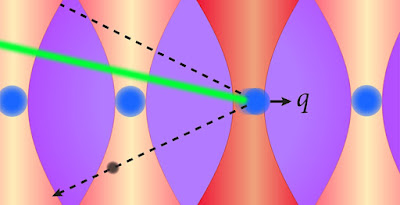
Figure 1: The dark matter detection scheme proposed by Afek and co-workers consists of nanospheres (blue) held in optical traps (red). If a dark matter particle (black) scatters off a nanosphere, it transfers momentum (q) to the nanosphere. A laser beam (green) detects the change in the nanosphere’s position caused by this momentum transfer.


For decades, experimental approaches for detecting dark matter have been driven by theory. Hypothetical particles called weakly interacting massive particles (WIMPs) were a byproduct of many theories developed to extend the standard model of particle physics. WIMPs remain viable and well-motivated dark matter candidates with masses above about 1 GeV∕c2 (roughly the mass of a proton). Other hypothetical particles known as axions remain attractive dark matter candidates for a range of masses below 100 meV∕c2.


Decades of searches for WIMPs and axions have so far come up empty handed. However, the next few years will see many experiments—such as ADMX, LZ, and XENONnT—with the sensitivity to cover much of the expected parameter space for these particles. This statement is by no means trivial: it took decades of vigorous technological development to get to this point. But what if dark matter is not WIMPs or axions? What other possibilities are there, and what opportunities arise for both theoretical model building and novel experimental approaches? Clearly, the significance of the dark matter problem mandates scientists to evaluate other concepts and cast the widest possible net. 


For this reason, there have been new proposals and new experiments that extend the detection sensitivity to other dark matter interactions and mass ranges. Notably, for WIMPs, dedicated experiments—including SENSEI, CRESST, and SuperCDMS—search for dark matter in the mass range below a few GeV∕c2. These experiments use extremely sensitive particle detectors, ranging from CCD chips to cryogenic calorimeters. Preliminary work has also been carried out on, for example, detectors containing superfluid helium that can discern the tiny amounts of crystal-lattice vibrations generated when a dark matter particle hits a target atomic nucleus in the detector. All these methods are optimized for the lowest-possible energy thresholds, which are particularly crucial when looking for sub- GeV∕c2 dark matter. 


Afek and co-workers’ approach is radically different (Fig. 1). Instead of measuring the energy imparted when dark matter scatters off a target, the authors propose to directly detect the momentum transferred to the target. Instead of using macroscopic detectors with a large mass (typically, kilograms or even metric tons), they suggest using levitated spheres that are only nanometers across. And instead of using detectors that rely on nuclear physics methods, they propose to use techniques from atomic, molecular, and optical physics. The nanospheres are optically trapped by a laser. Then their positions are read out with high precision by a second laser containing squeezed light—a state of light in which one component of quantum noise is lower than a fundamental limit called the standard quantum limit. The particular proposal calls for 10 dB of quantum-noise reduction relative to the standard quantum limit, which is challenging, but it has been demonstrated in similar systems. 


The authors realized that the size of the trapped nanospheres can be tuned to optimize the sensitivity of the experiment to dark matter. If a light dark matter particle scatters off a nanosphere, the wavelength associated with the imparted momentum can be larger than the nanosphere. In that case, the scattering process will be coherent over the entire nanosphere: the dark matter particle will interact with all the nucleons (neutrons and protons) of the nanosphere at once. Basic quantum mechanics tells us that the probability of such scattering is calculated by adding up the individual dark matter-nucleon scattering amplitudes for each nucleon and then squaring the result. Therefore, the scattering probability scales with the square of the number of nucleons. For a nanosphere containing 106 nucleons, the probability is thus enhanced by a huge factor ( 1012). This effect, together with the high readout sensitivity offered by squeezed light, explains the incredible promise of the proposed method. 


However, for an experiment to be sensitive to dark matter, it is not enough to be able to detect dark matter signals. Crucially, the experiment also needs to be able to suppress or distinguish all relevant backgrounds that would otherwise mimic a dark matter signal. Afek and colleagues make the best effort to estimate known backgrounds for their levitated nanospheres. They find that interactions between residual gas particles and the nanospheres are tolerable in a routinely achievable ultrahigh vacuum; that thermal noise is acceptable at moderate cryogenic temperatures; and that a few other backgrounds should not swamp a dark matter signal. 


Backgrounds will limit the sensitivity of the proposed experiment and will drive its design and operation. For instance, to improve the signal-to-noise ratio, the experiment will need to be scaled up to a large array of nanospheres. Nevertheless, the prospects are thrilling. Should signals be seen, their dark matter origin could be disentangled from instrumental artifacts or other backgrounds through their momentum spectrum and through their dependence on the nanosphere material. In addition, given that Earth completes one rotation each day, the direction of the momentum imparted by dark matter is expected to exhibit a daily modulation, which would be a smoking gun for dark matter scattering. 


Whether all these expectations hold true remains to be seen; the proposed experiment is not easy by any standard, and the requirements on its signal sensitivity and background control are extreme. Yet the authors are part of a small but growing community that is pursuing innovative detection methods, exploiting progress from atomic, molecular, and optical physics to address the dark matter problem. The next few years will be very exciting. While conventional experiments are probing the most promising regions of the WIMP and axion parameter spaces, entirely novel detection schemes are being proposed, with potentially transformative improvements for the sensitivity of experiments to dark matter.


References

1. G. Afek et al., “Coherent scattering of low mass dark matter from optically trapped sensors,” Phys. Rev. Lett. 128, 101301 (2022).

2. T. Braine et al. (ADMX Collaboration), “Extended search for the invisible axion with the Axion Dark Matter Experiment,” Phys. Rev. Lett. 124, 101303 (2020).

3. D. S. Akerib et al. (LUX-ZEPLIN Collaboration), “Projected WIMP sensitivity of the LUX-ZEPLIN dark matter experiment,” Phys. Rev. D 101, 052002 (2020).

Share:

Quantum Teleportation with Imperfect Quantum Dots - Practicalintroduction Area

Initially pursued as one of the most surprising consequences of the concept of entanglement in quantum information science, quantum teleportation has been increasingly investigated as a basic element for various applications in quantum technology over the course of the last couple of decades. The photonic implementation of the protocol is essential to the exchange of qubits over long distances and in fully-fledged quantum networks. Which technical platform has the better potential for bringing these applications to reality is still a questionbopen for debate, even in the light of the impressive achievements reached with state-of-the-art solutions. One of the main requirements concerns the generation of entangled photons. In order to reduce losses and enable more complex functionalities, a deterministic photon source would be a fundamental asset, which is a major obstacle for probabilistic sources. Semiconductor quantum dots (QDs) are a promising candidate for achieving on-demand operation. They can produce photon pairsin a nearly deterministic fashion with extremely low multiphoton emission and potential operation rates up to the GHz regime, even under electrical pumping. As the light collection efficiency of the source and the degree of entanglement18 of QD-based photon sources is constantly improving, their performance is closing the gap with spontaneous parametric downconversion.

In recent years this series of achievements has led to seminal demonstrations of quantum teleportation using entangled QD photons to transfer qubits encoded in either an attenuated laser pulse or a single photon generated on demand by the same QD23. While these results paved the way for a following generation of four-photon experiments, imperfections of the source still played a significant role forcing to either work at low values of protocol fidelity or with narrow temporal post-selection. Dealing with these hurdles is especially relevant when considering the future roadmap for QD-based quantum communication, which inevitably points at remote QDs, posing additional demands on photon indistinguishability. While these challenges keep motivating research on the QD fabrication, dealing with imperfect sources will certainly be mandatory in real-life applications. So far, little is known on the role of specific QD imperfections on the performance of quantum communication protocols. In this work, we study in detail the impact that imperfections in the entangled photon source have on the success of the quantum teleportation operation. We investigate different schemes, comparing the simplest that selects only one out of the four Bell states to the one that implements a polarization-selective Bell state measurement (BSM). We find that these approaches notnonly differ in the protocol efficiency but, remarkably, also in the teleportation fidelity, by removing unwanted coincidences of distinguishable photons. Their performance can be further improved when moderate spectral filtering is applied. To show the relevance of our approach, we present our results using a below-par QD, i.e., one whose figures of merit (in terms of entanglement and indistinguishability) are below the average value found on the same sample. In this case, the average teleportation fidelity can be brought from below the classical limit—that is, failure ofthe protocol—to values as high as 0.84. The experimental results are supported by a detailed theoretical model that explains how the imperfections of the source can be mitigated by the choice of the protocol. Our work thus shows that the search for the perfect QD can be avoided and that the current quality of state-of-the-art QD entangled-photon sources is not so far from the more stringent requirements set by secure quantum communication applications.

Efficient all-photonic quantum teleportation requires fast and deterministic sources of highly indistinguishable and entangled photons. Solid-state-based quantum emitters—notably semiconductor quantum dots—are a promising candidate for the role. However, despite the remarkable progress in nanofabrication, proof-of-concept demonstrations of quantum teleportation have highlighted that imperfections of the emitter still place a major roadblock in the way of applications. Here, rather than focusing on source optimization strategies, we deal with imperfections and study different teleportation protocols with the goal of identifying the one with maximal teleportation fidelity. Using a quantum dot with sub-par values of entanglement and photon indistinguishability, we show that the average teleportation fidelity can be raised from below the classical limit to 0.842(14). Our results, which are backed by a theoretical model that quantitatively explains the experimental findings, loosen the very stringent requirements set on the ideal entangled-photon source and highlight that imperfect quantum dots can still have a say in teleportation-based quantum communication architectures.


Practicalintroduction.com


Fig. 1 Main properties of the investigated QD. a Photoluminescence spectrum of the investigated QD under resonant two-photon excitation of the XX state. In the central inset, the radiative cascade process is sketched with its energy diagram. b Real part of the experimental density matrix which describes the polarization state generated via the XX-X cascade in the rectilinear basis. c Intensity correlation histogram (blue dots) recorded in a HOM experiment on X photons with a relative emission delay of 1.8 ns. The data are fitted with the sum of five Gaussian functions convoluted to an exponential decay (red line), sharing the same FWHM. The fitted area of the side peaks is highlighted. The estimated interference visibility is also reported.

Practicalintroduction.com


Fig. 2 Quantum teleportation using a QD photon emitter. Schematic illustration of the quantum teleportation setup. The BSM is implemented as shown in the dashed box, with a non-polarizing beam splitter (BS) followed by two polarizing beam splitters (PBS) at its output ports, allowing for the detection of two different Bell states. In the solid boxes we highlight the setup variations compared in this work. The detectors on the same side of the BS can be grouped to simulate the simpler procedure without polarization-selective elements. The X photons can be filtered with an etalon whose bandwidth is approximately twice the radiative linewidth of the QD emission.

Share:

Spin Quantum Heat Engine Quantified by Quantum Steering - Management Practicalintroduction

 Exploring thermodynamics at the quantum level opens up intriguing possibilities, including testing information theory in the quantum regime, the development of quantum fluctuation theorems, and the realization of microscopic quantum heat engines (QHE). In particular, microscopic QHE may operate more efficiently for work extraction than its classical counterpart by exploring the quantum effect. Over the years, enthusiastic interests have been devoted to implementing QHE by controlling l nonequilibrium dynamics in various microscopic systems, such as atomic systems, trapped ions, solid-state spin systems, photonic systems, single-electron transistors, nuclear magnetic resonance, superconducting qubits, among others. As quantum coherence is an intrinsic property for quantum systems, previous studies have intensively investigated the role of quantum coherence by using single particles or few-level quantum systems as the working medium. Recently, some researches show this potential high efficiency, while the other investigations show that quantum coherence effects are generally detrimental to reaching bounds on the maximum efficiency and power of these efficient thermal engines. Hence understanding the advantage of quantumness in QHE qualitatively and quantitatively remains a central issue from both a fundamental and practical perspective of quantum thermodynamics. In this work, we report an experimental demonstration of a quantum heat engine that can truly exhibit quantum advantage. By building a quantum Szilard engine, where quantum correlation exists between the working medium and the thermal bath, we have conclusively identified quantum correlation as a source of quantum advantage for QHE, since the reduced state of its working medium is a Gibbs state that naturally excludes the intrinsic coherence feature. By quantifying the correlation with quantum steering, we clearly show that an optimized steering-type inequality, which is expressed by the average work over different ways of work extraction on the working medium, can distinguish quantum Szilard engines from classical heat engines. The more the quantum steering inequality is violated, the more average work the quantum Szilard engine can output than its classical counterpart.


Following the rising interest in quantum information science, the extension of a heat engine to the quantum regime by exploring microscopic quantum systems has seen a boom of interest in the last decade. Although quantum coherence in the quantum system of the working medium has been investigated to play a nontrivial role, a complete understanding of the intrinsic quantum advantage of quantum heat engines remains elusive. We experimentally demonstrate that the quantum correlation between the working medium and the thermal bath is critical for the quantum advantage of a quantum Szilard engine, where quantum coherence in the working medium is naturally excluded. By quantifying the non-classical correlation through quantum steering, we reveal that the heat engine is quantum when the demon can truly steer the working medium. The average work obtained by taking different ways of work extraction on the working medium can be used to verify the real quantum Szilard engine.

practicalintroduction.com


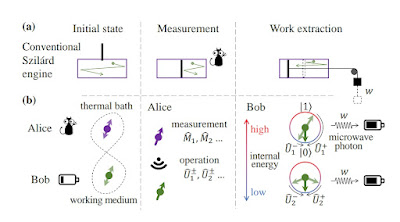
FIG. 1. Conventional and modified Szilard engine. (a) For the conventional Szilard engine, the working medium is a single atom that initially stayed in a thermal equilibrium state. A demon measures which half of the box the atom is in. If the atom is in the right half of the box, a movable shutter is put down in the middle. Then the shutter is hung to a load and extracts work from the atom. (b) For the modified Szilard engine, both the working medium and the bath are resembled by a single spin qubit respectively. Alice (the demon) prepares the initial state of the whole system, performs measurement Mˆi on the bath qubit, and tells Bob the operations Uˆ±i depending on the measurement outcomes ±1. Bob implements the operations Uˆ±i on the working medium qubit to extract work from its internal energy.

practicalintroduction.com

FIG. 3. Difference between work extracted from classical and quantum global states. The quantum (classical) global state is a pure entangled state ρ1 (separable state ρ2). The blue (red) data points are the work difference of measurement Mˆ1 = σz (Mˆ2 = σy), with errorbars representing one standard deviation. The solid lines are the theoretical predictions. For the Mˆ1 measurement, work extraction from both the classical and quantum global states are optimal, yielding the same extracted work. While for the Mˆ2 measurement, work extraction from the classical state is no longer optimal, and can extract less work than from the quantum global state.


Conclusions

We have experimentally demonstrated a truly quantum Szilard engine in diamond when the demon can "steer” the working medium where an optimized steering-type inequality that we derived can be violated. Our theoretical and experimental results show that a quantum heat engine which excludes intrinsic coherence feature in working medium, can truly exhibit quantum advantage. We hope our work triggers further studies to generalize our results to the other kind of quantum heat engines. Our work can be naturally extended to the case of the working medium with higher dimensions. In the future, it will be interesting to study these heat engines where the working medium is a higher dimensional system. The investigation of quantifying genuine high dimensional quantum steering can benefit to it. As well, our research can stimulate the bloom of high-dimensional quantum steering.

Share:

Euler Imagined Group of 36 Army Officers A Quantum Solution to an 18th-Century Puzzle


practicalintroduction.com

A sudoku-style mathematical puzzle that is known to have no classical solution has been found to be soluble if the objects being arrayed in a square grid show quantum behavior [1]. The problem, posed by Swiss mathematician Leonard Euler in 1779, involves finding a way to arrange objects in a grid so that their properties don’t repeat in any row or column. The quantum solution might be useful for problems in quantum information processing, such as creating algorithms for correcting errors in quantum computing.


Euler imagined a group of 36 army officers, six from each of six regiments, with each officer having one of six different ranks. Can they be arranged in a square formation such that no regiment or rank is repeated in any row or column?


Solutions can be found for all squares ( 3×33×3, 4×44×4, and so on, assuming the appropriate number of officers) except for 2×22×2 and Euler’s case of 6×66×6. In 1900, the impossibility of a 6×66×6 solution was proven by the French mathematician Gaston Tarry. But Suhail Rather of the Indian Institute of Technology Madras (IITM), Adam Burchardt of Jagiellonian University in Poland, and their colleagues wondered if the problem could be solved if the objects were quantum mechanical instead of classical. Then the objects could be placed in combinations (superpositions) of the various possible states: a single officer could be, say, partially a colonel from the red regiment and partially a lieutenant from the blue regiment.


This quantum version requires an adjusted definition of when two such states can be considered “different.” Quantum superpositions can be represented as vectors in the space of possible states of the components, and the team assumed that two superpositions are mutually exclusive if their vectors are perpendicular (orthogonal) to one another.


The researchers used a computer algorithm to search for such quantum solutions of Euler’s “36 officers” problem. They started from a classical configuration that had only a few repetitions in the rows and columns and tried to improve it by adding in superposition. They found that a full quantum solution to the 6×66×6 problem exists for a particular set of superposition states.


A superposition between two quantum objects often implies that they are entangled: their properties are interdependent and correlated. If, say, one quantum officer is found (on inspection) to be a colonel, the other with which it is entangled might have to be a lieutenant. The quantum solution requires a complicated set of entanglements between officers, reminiscent of the entanglements created between quantum bits (qubits) in quantum computing.


The researchers realized that their solution is closely related to a problem in quantum information processing involving “absolutely maximally entangled” (AME) states, in which the correlation between any pair of entangled qubits in the group is as strong as it can possibly be. Such states are relevant to quantum error correction, where errors in a quantum computation must be identified and corrected without actually reading out the states of the qubits. AME states are also important in quantum teleportation, where the quantum state of one particle in an entangled pair is recreated in the other particle.


Qubits have two possible readout states, 0 and 1, but quantum objects can, in principle, also have three (qutrits) or more states. Theorists have derived mathematical expressions for AME states for different-sized groups of quantum objects, but an AME state for four six-state objects (so-called quhex objects, like quantum dice) has proven curiously elusive. Rather and colleagues found that their quantum solution to the 6×66×6 Euler problem shows how to entangle four quantum dice to also produce this so-called AME(4,6) solution. The lack of an AME(4,6) state had been puzzling to theorists, but the solution required an approach that had not been previously considered. The result shows a new design principle for creating states with entangled particles, an essential element of error-correcting codes, says team member Arul Lakshminarayan of the IITM.


Finding the AME(4,6) state solves “a problem that has been investigated by several researchers within the last few years,” says quantum information theorist Barbara Kraus of the University of Innsbruck in Austria. Quantum technologist Hoi-Kwong Lo of the University of Toronto says the work is potentially significant. “The argument looks plausible to me, and if the result is correct, I think it is very important, with implications for quantum error correction.” But he admits that it’s not easy to understand intuitively why the six-state case turns out to be so special, both for Euler’s problem and for the AME states.


References

  • S. A. Rather et al., “Thirty-six entangled officers of Euler: Quantum solution to a classically impossible problem,” Phys. Rev. Lett. 128, 080507 (2022).


Share:

Planets Born from Dying Stars - Management Practicalintroduction


practicalintroduction.com

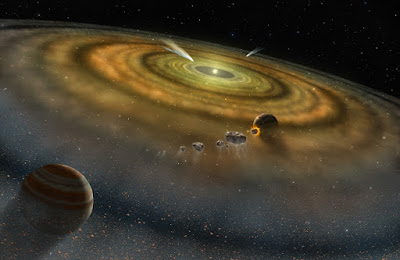
Researchers have discovered binary-star systems that have an unusual cavity at the center of their surrounding disk of gas and matter (right). This cavity might be evidence that planets form in these systems.


Scientists studying the births of planets typically spend their time analyzing the rings of dust, known as protoplanetary disks, that form around freshly burning stars. From this dust, they have seen evidence of matter coming together to form protoplanets that, like Earth, orbit a single star. Now, Jacques Kluska and Hans Van Winckel from KU Leuven, Belgium, and colleagues report observations that indicate that there might exist another route for stars to birth planets. This finding could help scientists better understand how common planets are in the Universe.


Kluska, Van Winckel, and colleagues consider a type of evolved binary-star system known as a post-asymptotic giant branch (post-AGB) binary. In this binary system, when one of the stars dies, a disk of cosmic building materials forms around the dead star—and the star that’s still alive. The makeup of such a disk has been shown to be very similar to that of a protoplanetary disk, which is known to birth planets. Van Winckel says that this similarity led him and his colleagues to decide to investigate the dust more deeply. “You could say that nature showed us the way,” he says.


In their study, Kluska, Van Winckel, and colleagues looked at 85 post-AGB binaries. They studied archival data for each system. They also collected new spectrograph data using the Mercator telescope in Spain. The team analyzed the infrared emission from each post-AGB binary to characterize the composition of its dust and to categorize the morphology of its disk. They then compared data from all the post-AGB binaries. They found that 10% appear to house a matter cavity at their centers. This cavity depletes iron and other refractory elements from the dying star’s surface.


To explain this element depletion, the team explored several causes, including the presence in the post-AGB binary of a star that is naturally low in the missing elements. But ultimately, they zeroed in on it arising from the existence of a newly formed planet. The presence of a young planet is the “best explanation we came up with,” Kluska says.


This finding opens a “new vista” for the study of the disks around post-AGB binaries, says Yanqin Wu, a professor of theoretical astrophysics at the University of Toronto, whose work focuses on the study of protoplanetary disks. “The planet hypothesis is titillating,” she says. “If new planets do form in the center of the disks around dying stars, they will be like a phoenix rising out of the ashes.” However, while Wu is intrigued by the team’s explanation for their findings, she is not convinced that a planet is the only solution to the observed puzzle and says “other physical explanations could connect the two dots.”


To find out if their planet hypothesis is correct, Kluska, Van Winckel, and their colleagues say that they plan to collect and analyze further data. Specifically, the team will use high-spatial-resolution images from observatories such as the Very Large Telescope and the Atacama Large Millimeter/submillimeter Array, both in Chile, to study the structure of the post-AGB binaries in more detail. If the planet hypothesis is proven correct, post-AGB binary systems could serve as a new laboratory to test models of planet formation, Kluska says.

Share:

Quantum Computing Arrays Made From Multiple Atomic Species, That Are Rubidium and Cesium Atoms


practicalintroduction.com

Using arrays of a single type of neutral atom, researchers have recently demonstrated that they can orchestrate atomic interactions for applications such as quantum computing or the controlled formation of single molecules. They are now looking to create neutral-atom arrays from multiple atomic species, something that could enable more advanced quantum computing protocols, for example. Toward that goal, Xiaodong He of the Wuhan Institute of Physics and Mathematics, China, and colleagues have now experimentally demonstrated how to produce arrays containing two different rubidium isotopes [1]. The demonstration parallels another by a team led by Hannes Bernien at the University of Chicago, which realized arrays of rubidium and cesium atoms [2].


Both teams used optical tweezers to arrange their atom arrays. He and his colleagues worked with two isotopes of rubidium. They loaded a mixture of around 30 rubidium-85 ( 85Rb85Rb) and rubidium-87 ( 87Rb87Rb) atoms into optical tweezer arrays from a magneto-optical trap. They then used fluorescence imaging to measure the initial array pattern that the atoms formed. Next, they rearranged the 85Rb85Rb and 87Rb87Rb atoms, using a movable tweezer to switch out one rubidium isotope for another so that they could create a specific array pattern. The steps of this switch-out process were determined by an algorithm that He’s team developed so that they could replace incorrect isotopes in the fewest possible moves.


Bernien’s team worked with cesium and rubidium, two atoms that interact with different wavelengths of light. Because of this difference, the team could independently trap the two atomic elements using different sets of tweezers and then arrange them in an array. They arranged about 300 atoms in total in an array with around 500 sites. Bernien’s team could also use one set of tweezers to reload one atomic species into the array while using the other to hold the second species still, a capability necessary to continuously implement quantum protocols.


He and his colleagues demonstrated a 2D checkerboard pattern of alternating isotopes, which they say is well suited for executing some types of quantum error correction code. They also made a 2D striped pattern. Bernien’s team also created various 2D patterns, including an arrangement that resembled the outline of the Sears Tower. In future work, both teams plan to use their arrays to demonstrate quantum computing protocols.


References

  • C. Sheng et al., “Defect-free arbitrary-geometry assembly of mixed-species atom arrays,” Phys. Rev. Lett. 128, 083202 (2022).


  • K. Singh et al., “A dual-element, two-dimensional atom array with continuous-mode operation,” arXiv:2110.05515.


Share:

Cavity Magnon-polaritons in Cuprate Parent Compounds (Published 15 June 2021) - Management Practicalintroduction

Management Practicalintroduction


Using light to control the properties of quantum materials not only holds the potential to realize new and interesting quantum many-body phases, but may also hold the key to create novel devices and functionalities. In most cases, this optical control is achieved by externally applying intense electromagnetic radiation to the system in question. Recently however, an appealing alternative route has been put forward which bypasses the need for intense external radiation. Instead ,one may attempt to use resonantly-coupled electromagnetic cavities to custom-tailor the properties of the electromagnetic vacuum-fluctuations directly.

A potentially powerful application of this approach is to use cavities to control antiferromagnetic correlations in a high-Tc cuprate superconductor. These correlations are believed to underlie many of the exotic, and potentially useful, aspects of the unconventional high-Tc superconductivity in these materials.

It therefore stands to reason that the ability to optically manipulate, and ultimately enhance, superconductivity in these materials is extremely appealing from both a theoretical and practical perspective, and may pave the way towards realizing room-temperature superconductivity—a “holy-grail” of modern condensed matter and material science. The concept of using cavities to manipulate superconductivity has already been put forward in the context of electron-phonon systems .

In this case, it has been proposed that strongly coupling resonant cavities to infrared-active optical phonons may offer away to manipulate the pairing between electrons in “conventional” superconductors. While indeed this may be a promising avenue towards achieving cavity-enhanced superconductivity, these systems still remain fundamentally limited by the relatively weak coupling strengths afforded by electron-phonon interaction. 

In contrast, while the exact mechanism responsible for superconductivity in cuprates is still unclear, it is widely believed to be driven by interactions of electrons with spin-fluctuations rather than phonons. As a result, these systems have a higher “ceiling” for potential enhancement effects. At the same time it is also less clear how cavities may be used to modify these spin-fluctuations. Motivated by these considerations, we propose a scheme for realizing strong coupling of a resonant cavity to the spin fluctuations in an antiferromagnetic cuprate parent compound.

Cavity control of quantum matter may offer new ways to study and manipulate many-body systems. A particularly appealing idea is to use cavities to enhance superconductivity, especially in unconventional or high-Tc systems. Motivated by this, we propose a scheme for coupling Terahertz resonators to the antiferromagnetic fluctuations in a cuprate parent compound, which are believed to provide the glue for Cooper pairs in the superconducting phase. 

First, with derive the interaction between magnon excitations of the Ne´el-order and polar phonons associated with the planar oxygens. This mode also couples to the cavity electric field, and in the presence of spin-orbit interactions mediates a linear coupling between the cavity and magnons, forming hybridized magnon-polaritons. This hybridization vanishes linearly with photon momentum, implying the need for near-field optical methods, which we analyze within a simple model then derive a higher-order coupling between the cavity and magnons which is only present in bilayer systems, but does not rely on spin-orbit coupling. This interaction is found to be large, but only couples to the bimagnon operator. 

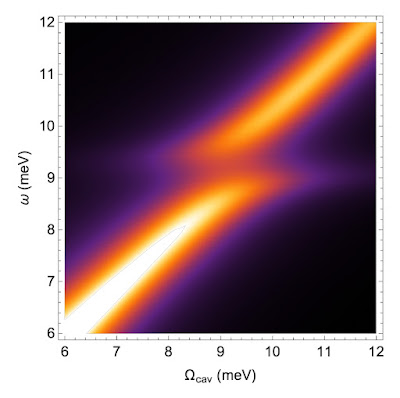
As a result find a strong, but heavily damped, bimagnon-cavity interaction which produces highly asymmetric cavity line-shapes in the strong-coupling regime. To conclude, we outline several interesting extensions of our theory, including applications to carrier-doped cuprates and other strongly-correlated systems with Terahertz-scale magnetic excitations.


Management Practicalintroduction


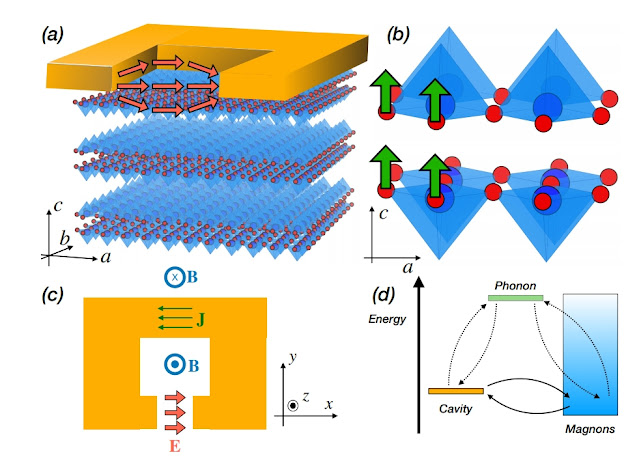
Overview of our proposal for forming cavity magnon-polaritons in insulating cuprates. (a) Depiction of the combined cavity-sample system. We consider placing the resonator on top of the cuprate (YBCO) sample, which is quasi-two dimensional and consists of layers of copper-oxide bilayers (for clarity we only depict the planar copper and oxygen atoms). The resonator produces a strong electric field (red arrows) which penetrates into the sample and couples to the magnons via the scheme outlined in Sec. II. (b) The phonon mode we consider in this paper, shown in a simplified depiction of the YBCO unit cell, is associated to the infrared-active motion of planar oxygens along the c-axis and strongly couples to both the cavity photons and the magnons in the cuprate. (c) Depiction of a typical split-ring resonator, which we use to model the Terahertz cavity in this work. Current flows through the metallic ring, inducing a magnetic field, as well as producing an electric field in the capacitive gap. (d) Cavity photon mode (gold) is constructed to lie close to the bottom of the magnon band (blue continuum), which are the two degrees we wish to couple to each other. The magnon-cavity coupling is mediated by virtual phonons, which both systems couple to directly. Because the phonon mode in question is higher in frequency than the relevant magnons and cavity, it can be adiabatically eliminated, yielding the desired cavity-magnon coupling.


reference :

S. Choi, J. Choi, R. Landig, G. Kucsko, H. Zhou, J. Isoya, F. Jelezko, S. Onoda, H. Sumiya, V. Khemani, C. v. Keyserlingk, N. Y. Yao, E. Demler, and M. D. Lukin, Observation of discrete time-crystalline order in a disordered dipolar many-body system, Nature (London) 543, 221 (2017).


M. Heyl, Dynamical quantum phase transitions: A review, Rep. Prog. Phys. 81, 054001 (2018).


Jonathan B. Curtis, Andrey Grankin, Nicholas R. Poniatowski, Victor M. Galitski, Prineha Narang, and Eugene Demler, Cavity magnon-polaritons in cuprate parent compounds, Cond-mat.str-el, (2021).

Share:

Happy Wolrd Teacher Day

Daily Page View

Label

Adobe Acrobat Adobe Photoshop Alexa Rank Andorid Application Art Austria BUMN Beginner Belgium Blog Community Blogger Bupati Gresik CPNS/PPPK Canada Coin Market Cap Computers Cosmology Cryptocurrency Dancing Denmark Doctoral Doker Education Educational Excel Excel Table Features Film Finland French Gadget Gallery Garuda Emas Germany Google Analytics Google Form Hardware Homestay Hong Kong Ilovepdf Indrawan Vpp Interior Design Ireland Italy KKPR dan PKKPR Kampung hijau Karang Taruna Karir/Career Keyword Keywords LKPM LaTeX Linux Lowongan Kerja BUMN/SWASTA Mac Majalah Tech Material Physics Material Physics. Mechanical Engineering (ME) Microsoft 365 Microsoft Excel Microsoft Office Microsoft PowerPoint Microsoft Word NFC Nero Nero Burning 2021 Networking New Technology OSS RBA OTOMOTIF Operating Systems Optic PDF PT Aerotrans Services Indonesia (Garuda Indonesia Group) PT Astra Tol Nusantara (ASTRA Infra) PT Indomarco Prismatama (Indomaret Group) PT Indonesia Epson Industry PT Jakarta Industrial Estate Pulogadung PT Pertamina Training & Consulting (PTC) PT. Indofarma (Persero) PT. Kimia Farma Group Perizinan Berusaha Persetujuan Lingkungan Pinjaman Online Posgraduate Postgraduate PowerPoint Presentations Profil Perusahaan/Company Profil Profil-Perusahan Publisher Pyrolysis Quantum Computing Quantum Physics Quiz Renewable Energy Research SEO SWASTA Scholarship Semi conductor Semiconductor Sertifikat Halal Smartphone Spintronic Study Abroad Super Capasitor Superconductor Tata Cara Pendaftaran Surat Izin Usaha Industri (SIUI) Technology Tecnology Thailand The Best Trip & Travel Tutorial United Kingdom United Stated United States VGA card Website Windows 365 Windows Tips Word Document WordPress Zero Waste chromium tricks font iphone iphone 13 Pro iphone 13 Pro Max iphone 13 Pro Max gsmarena online zodiak